A Golden Path for Agents
Platform engineering has one trick, and it works almost everywhere you point it. Find the thing every team keeps rebuilding, build it once with safe defaults, leave a few knobs, and put guard rails around the knobs. That is what a universal Helm chart is for deployments, what hardened base images are for containers, and what shared GitHub Actions are for CI. Eighty percent of teams never need anything else, and the other twenty get an escape hatch and a review.
Then agents showed up, and for a while the trick had no answer.
The people asking were not the usual suspects, either. A support lead had a prompt and wanted it to read tickets. An analyst had a Python script that called a model and ran generated code over CSV files. A developer had a small chat app that worked great on a laptop. Nobody in that group wanted to learn about workload identity or egress policy, and every one of them was about a day away from pasting an API key into a Deployment.
So what does the golden path look like for this? I spent a week finding out and then building it, and the whole thing now lives in one public repo that runs end to end on a laptop. This post is what I learned along the way.
What an agent needs that an app does not
Strip away the hype and an agent is a service with three extra habits. It spends money on every request, it calls tools that can change things, and it was probably written by someone who does not think of themselves as a backend engineer. None of those are hard on their own, but together they are exactly the gaps a normal app chart does not cover.
The research phase (full notes here) turned up no standard for deploying agents, just a set of parts that are starting to converge. The MCP spec now treats tool servers as OAuth resource servers. OpenTelemetry has draft conventions for agent and tool spans. OWASP published a top ten for agents in December 2025. And the companies actually running agents at scale have all built roughly the same thing: a thin layer on the platform they already had, with a gateway sitting in front of models and tools. Uber gives each agent a workload identity and routes every tool call through one MCP gateway. Stripe runs its coding agents in sandboxes with no internet and keeps a human on every PR.
What none of them did was buy a hosted agent runtime for the default path, and neither did I. The org already had Kubernetes, Helm, Argo CD, and GitHub Actions, so agents became one more workload type, one that happens to have a stateful process, a gateway dependency, and a budget.
What the developer sees
This is the entire contract:
# deployments/agents/demo/vibe-app/values.yaml
name: vibe-app
team: demo
owner: dackota.j@gmail.com
description: A chat app that calls an LLM and one read-only tool.
kind: container
image: ghcr.io/dackota/agent-app-template:0.2.0
systemPrompt: You are a friendly helper. Keep answers under 30 words.
tools:
  - name: k8s-readonly
budget:
  usdPerMonth: 10
Open a PR with that file and CI renders it against the chart schema, failing
with the exact field name if something is off. Merge it, and about a minute
later the agent is answering at /agents/demo/vibe-app/ on the platform
gateway. It can call three read-only Kubernetes tools, it can spend ten
dollars a month, and at no point did anyone hand it a credential.
The kind field is the one big switch. prompt is a system prompt plus tools
and no code at all, which is what the support lead needed. container is your
own image, for the developer with the chat app. codeexec hands you an
isolated sandbox from a warm pool, which is where the analyst’s script
belongs. One chart renders all three, and it only renders the resources a
single agent needs. Anything shared or privileged lives outside the chart, and
outside the team’s reach.
What the platform does
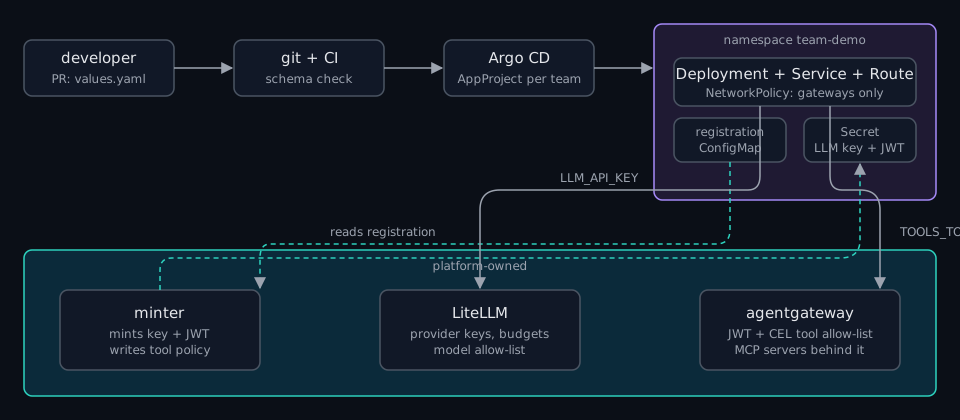
The core idea is that two gateways hold every credential, so the agents never
have to. LiteLLM is the LLM gateway. It keeps the
real provider keys and hands each agent a virtual key with a hard
max_budget, a model allow-list, and rate limits, and because spend is
tracked per key, cost per agent and per team falls out for free.
agentgateway is the tool gateway. It sits in
front of the MCP tool servers, requires a JWT, and applies one small CEL policy
per agent that says which tool names exist for it. Tools outside that list
are simply absent from tools/list, so the model cannot try what it cannot
see.
A NetworkPolicy then makes those two gateways, plus DNS, the only things an agent pod can reach. I tested this the boring way: a pod with the policy could not reach the model host directly, the same pod could reach the gateway, and a control pod without the policy reached the model host just fine.
The piece that makes GitOps actually work here is a small minter. The chart renders a registration ConfigMap for every agent, and a platform CronJob reads them, mints the LLM key and the tool JWT, writes both into a Secret in the team namespace, and applies the tool policy. Pods wait for the Secret and then start. Delete the folder and the minter deletes the Secret and the policy along with it. It is eighty lines of stdlib Python, and it is the only process anywhere that ever touches the master key.
Argo CD ties all of it together with a git-directory ApplicationSet over
deployments/agents/*/* and one AppProject per team. The project allows one
source repo and one destination namespace and forbids cluster-scoped
resources, and I spent a while trying to break it. An Application aimed at
another namespace was refused. An Application from a foreign repo was refused.
When Argo tried to create a namespace on the team’s behalf, the project
refused that too, which is how I learned that namespaces belong in
platform-owned files.
The guard rails, and how I know they hold
Every rail was tested, and the failing test sits next to the rule in docs/guard-rails.md. The short version:
| Rule | Proof |
|---|---|
Only catalog models, only catalog tools, only allowed registries, no :latest | eleven bad values files, all rejected before render |
| Hard budget per agent | a key with a $0.0001 budget: first call ok, second call “Budget has been exceeded” |
| Per-agent tool allow-list | one token lists 3 Kubernetes tools, another lists 3 order tools, same endpoint |
| Default-deny egress | pod to model host: unreachable. Pod to gateway: 200 |
| Human approval on writes | “Cancel order 1004” stopped in input-required; the order was untouched |
| Delegation needs consent | an agent in an unlisted namespace named another team’s agent as a tool: refused |
| Removal is complete | deleted a folder: CronJob, ConfigMaps, and the minted Secret all gone |
The one I keep coming back to is the approval gate. A prompt agent that
lists the orders-cancel tool with approval: true will stop and wait for a
human before the tool runs, and that pause is the whole difference between an
agent that can cancel orders and an agent that can ask to.
Two things that make agents a system
Tools that only search the web are not that interesting. The tools worth
having are the company’s own APIs, so the repo ships with a fake Orders REST
API and a ninety-line MCP server that wraps it with no framework at all: one
tool per API call, a JSON schema per tool, and the HTTP call inside. kagent’s
MCPServer resource deploys it, a RemoteMCPServer shares it with agent
namespaces, and the same server shows up as a second target on the tool
gateway so container agents can reach it through the JWT check. Wrapping the
next API is a copy of one file.
The other half is that agents should not know how to do everything. They
should know who to ask. kagent lets an Agent list
another Agent as a tool, with the call going over A2A between pods, and in
values that is one line on each side. The caller says
tools: [{agent: ops/orders-agent}] and the callee says
delegation: {allowFromTeams: [demo]}. Both have to agree, kagent enforces
the callee’s half, and when I asked the concierge in one team about an order,
it went and asked the specialist in another team and the response history
showed the hand-off.
Things that bit me
Helm’s schema validator is Go regex, which means no lookahead. My (?!latest)
compiled nowhere and failed every single render with an error about the
schema rather than the values. not with a pattern does the job instead.
Anything rendered from now makes Argo permanently OutOfSync. I wanted
sandboxes to expire eight hours after creation, and they now take an explicit
timestamp instead.
agentgateway starts prefixing tool names the moment a backend has two targets,
so k8s_get_resources quietly became kagent-tools_k8s_get_resources and the
model happily called it by the new name. prefixMode: Never, plus a rule that
catalog names may not collide.
kgateway 2.4 does not bundle agentgateway any more. My research note said “agentgateway behind kgateway” because 2.1 did, but agentgateway ships its own Gateway API control plane now. Re-check the install docs the day you install, not the week before.
And a public repo cannot call a reusable workflow that lives in a private one, which I found out when the template repo’s first build failed in zero seconds. The shared build workflow moved to a public repo and that was that.
What is still missing
This is a proof of concept on kind, and the README says so plainly. For a real cluster, the org identity provider becomes the JWT issuer instead of a platform RSA key, the sandbox template turns on gVisor, image signatures get verified at admission rather than only in CI, an OpenTelemetry collector lands where the chart already points, and the minter grows up into a controller with a watch, or gets replaced by External Secrets Operator. Each of those is listed next to its local stand-in in the platform guide.
What I would not change is the shape. One values file. Two gateways that own the credentials. A minter that turns “this agent exists” into “this agent has keys”. A project boundary that Argo enforces so the platform does not have to argue about it. The developer gets a URL and a budget, and the platform gets the same agent every time.
The repo is at github.com/dackota/agent-golden-path,
and make up builds the whole thing on a laptop with a local model. Every
claim in this post has a test sitting next to it.